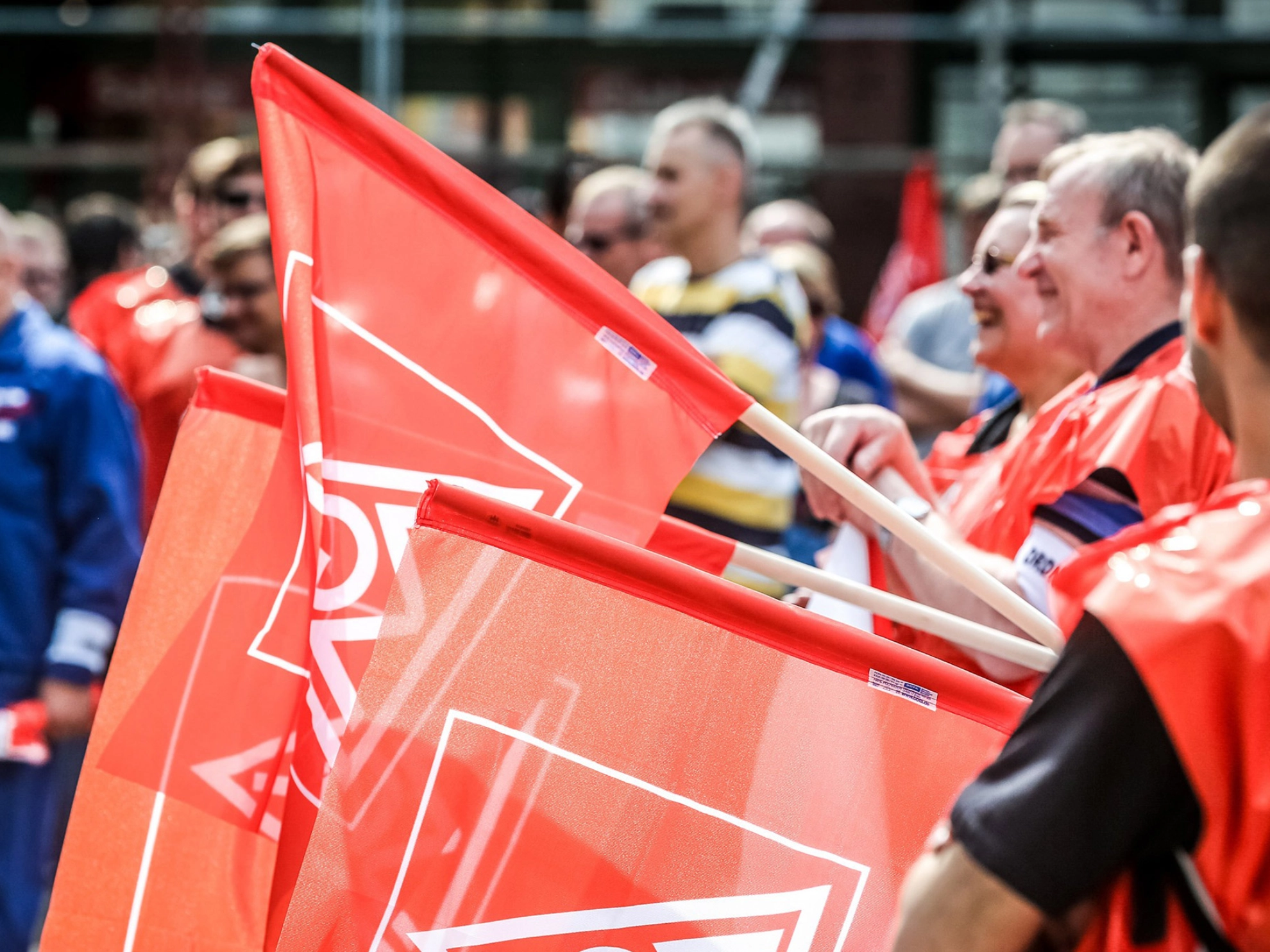
Eine Reihe Männer hält IG Metall-Fahnen.

Frequently asked questions
FAQ

We provide information on frequently asked questions.

Who can become a member of IG Metall?

  • Anyone can become a member of IG Metall! We support and represent engineers, controllers, developers, and software engineers. Other sectors include metal and electrical, steel, textiles and clothing, wood, plastics, renewable energy, and information and communications technologies.
  • However, we are also always open to colleagues who are not in a company, such as the unemployed and pensioners, who can pay a reduced contribution to continue to support our work. They benefit, in particular, from our legal advice on their legal rights which is free of charge for our members.

I’m not sure IG Metall is the right trade union for me. How can I find out if you cover my industry or company?

  • IG Metall represents industries and job categories that are growing, including IT, software, engineering, and design.
  • If your company makes any kind of hardware: You are definitely in the right place! Otherwise, ask yourself what kind of collective agreement would apply to your company. Is it perhaps a subsidiary of a company that already has an existing collective agreement with IG Metall?
  • Some colleagues want to switch from another union to us. This is very easy to do. You will retain your rights to trade union benefits, such as employment and social legal protection. Your previous years of membership will also be recognized if you’re entitled to a strike fund. If you are not sure to which union you belong to, please get in touch with us!

Why should I democratize my workplace? Personally, I have everything under control?

  • Glad to hear it! Still, all organizations have power dynamics - you have workers on one side and executives on the other. Therefore, there will always be inevitable hierarchies. As long as there are people who have power over you, you can have issues, even if they seem minor to you. Unions can help manage those structures! Be it with support for you in operational business issues, renumeration, and working conditions or by providing mechanisms for more transparency, diversity, and inclusion.  

Will the employer know about my membership?

  • No. The employer has no right to know which employees are union members or not. This is one of the reasons why we often do not reveal membership figures before we have a viable number to start actions like collective bargaining.
  • Of course, each member has the right to be open about their membership and to convince their colleagues to join, if they want.

Trade unions sometimes seems so radical?

  • It’s always a question of perspective! In the 19th century it was radical to campaign to reduce the 12-hour day! But we don’t want to do anything that you don’t agree with. We are only seeking what most workers, and especially our members, want. Collective agreements raise the minimum standard for everyone, without overburdening companies financially. Collective agreements are well-established, legally enshrined instruments for improving and reforming your workplace in Germany.

What does the German word "Mitbestimmung" mean?

  • Co-determination (“Mitbestimmung”): This term can also mean “self-direction”. Employees have a right to co-determination. Because their voice is important in shaping a fair workplace, both through works councils and in company decision-making on the supervisory board. However, many companies don’t takes steps to support codetermination or sometimes they just completely ignore it.

Who or what is a works council and why is it needed in my workplace?

Works councils („Betriebsrat“): A works council is a committee that acts as a direct representative of the employees in a company. Works councils, as they are known in Germany, exist mainly in Europe. In Germany, their framework is defined in the Works Constitution Act (Betriebsverfassungsgesetz). IG Metall can help you set up a works council as the process can be complicated. We also train elected works councils in legal, social, and economic matters and support them in their day-to-day work. The role of the works council includes:

  • Making sure that everyone is treated fairly in a company
  • Making sure that collective agreements are respected in a company
  • Checking a company’s financial statements and safeguarding jobs
  • Managing employee data protection
  • Taking part in decisions about the workplace design and the way work is organized
  • Promoting work/life balance
  • Negotiating works agreements

My colleagues and I would like to be paid more. Can a works council also negotiate for higher salaries?

  • No, it cannot. For most workplace matters that go beyond the legal framework of the Works Constitution Act, you need a trade union. In Germany, bargaining for collective agreements (for example on pay, holidays, and daily working hours) can only be done by trade unions and their members. If you want more than just a works council, we can help you to set up a union at your workplace, organize the rank-and-file in your company, and negotiate for better working conditions.

Everyone talks about collective agreements. What are they?

  • Collective  agreements (“Tarifvertrag”) are written contracts between trade unions and employers’ associations or individual employers  that regulate the content, the conclusion and the termination of employment relationships. As the name suggests, these agreements are made with the collective agreement of workers. They must be seen as a minimum standard for everyone in a company (“in-house agreement”) or a whole regional industry (“sectoral collective agreement”). Therefore, the workforce involved must be highly unionized. This both increases the bargaining power to push through joint demands and ensures that the demands reflect the opinion of the majority of employees.
  • Under German law, collective agreements take precedence over company agreements. This means they are more legally binding than individual employment contracts that each employee receives from their employer or than works agreements by a works council.

Why do I need a collective agreement if I can negotiate my own salary?

When salaries are negotiated individually, there can be significant disparities among employees doing similar work. Salary levels are often not very transparent and executives may unconsciously favor certain employees over others. Collective agreements offer several advantages that individual negotiations might not:

  • Stronger Negotiating Power: Unions can negotiate better terms collectively than individuals can on their own. This often results in higher wages, better benefits, and improved working conditions.
  • Consistency and Fairness: Collective agreements ensure that all employees receive fair and consistent treatment. This helps reduce disparities, such as gender pay gaps.
  • Job Security: Collective agreements often include provisions that protect against arbitrary dismissal and ensure fair processes for resolving disputes
  • Additional Benefits: Beyond salaries, collective agreements typically cover a range of benefits like retirement plans, vacation time, and professional development opportunities.
  • Predictability: Employers and employees both benefit from the predictability and clarity that Collective Agreements provide on wages, working hours, and other employment terms.
  • Even with a collective agreement in place, you can still negotiate additional terms individually if you wish. The collective agreement sets a strong foundation, ensuring that you and your colleagues are treated fairly and equitably.

What can an IG Metall collective agreement cover?

They can, but don’t have to, regulate, issues such as:

Remuneration:

  • Pay scales for blue-collar and white-collar workers according to specific job descriptions
  • The proportions of the pay groups
  • The principles of remuneration such as hourly rates, incentive bonuses, and other alternatives.
  • Pay increases
  • The number of extra payments and bonuses (Christmas bonus, special savings funds)
  • Wage guarantees for older employees

Working time:

  • Weekly working hours
  • Length of holidays and holiday pay
  • Extra pay for overtime
  • Extra pay for shift work, or night or weekend work
  • Notice period

Who benefits from collective agreements?

Collective agreements raise the minimum standard for everyone, regardless of where they fall in the company hierarchy. However, the provisions of a collective agreement are only legally binding for trade union members. The employer is not obligated to guarantee the benefits of a collective agreement to employees who are not union members.

  • Employees often get higher wages, better working conditions, more vacation time, and additional benefits such as health care and pension plans. Collective agreements also help to reduce pay gaps, such as the gender pay gap.
  • Employers gain clarity and predictability when it comes to labor costs and working conditions, which can lead to more harmonious labor relations and fewer industrial actions.
  • Society: This may sound far-fetched, but it’s true! Collective agreements contribute to social stability by promoting fair wages and working conditions, which can reduce income inequality and improve overall economic well-being.

What's the difference between collective agreements and work agreements?

  • Collective agreements rely on Article 9 of the German Constitution and the Collective Agreements Act and are negotiated between employers‘ associations or individual employers and the trade unions. They are valid for all employers affiliated with an employers‘ association and for all union members. They determine general rules regarding working time, wages, vacation, etc.
  • Works agreements rely on the Works Constitution Act (Betriebsverfassungsgesetz) and are negotiated between a particular company and its works council. They are valid for all employees in the company and often address operational business more than collective agreements.

What’s the difference between IG Metall collective agreements and the legal minimum standards for working conditions?

IG Metall collective agreements provide significantly better working conditions than the legal minimum standards. Employees benefit from more vacation (30 instead of 20 days), shorter working hours (35 instead of 48 per week), and additional payments such as holiday and Christmas bonuses. They also receive paid leave for special occasions, guaranteed employment after vocational training, and longer notice periods. Overall, the agreements offer stronger protections and improved benefits compared to basic legal requirements.

Why is there a membership fee?

IG Metall is financed exclusively by the contributions of its members. Every member not only provides for themselves with their contribution, but also stands up for others. That is our principle of solidarity. Our statutes regulate who pays how much.
All of our services are financed by the contributions of our members. The contributions of over 2.2 million people make us strong and, above all, assertive.

Full-time and part-time employees, trainees, solo self-employed persons pay one percent of the average monthly gross income, full-time and part-time employed members, members in company-based training, in part-time and work-integrated forms of training and study and solo self-employed persons.
Who pays how much membership fee?

Members in full- and part-time employment pay one percent of their average monthly gross income. Reduced fees may apply if you are a pensioner, unemployed, or on parental leave.

Tax Deductibility of Membership Fees

You can deduct your union membership fees from your taxes, as they are considered work-related expenses. Typically, you will need proof of your contributions, which can be downloaded here.

These expenses are fully deductible regardless of the amount, as long as they are related to your profession. Pensioners are also eligible to deduct their trade union contributions.